 ..
..OUR TELESCOPES
Astro Photos are HERE
Tele Vue-NP127is
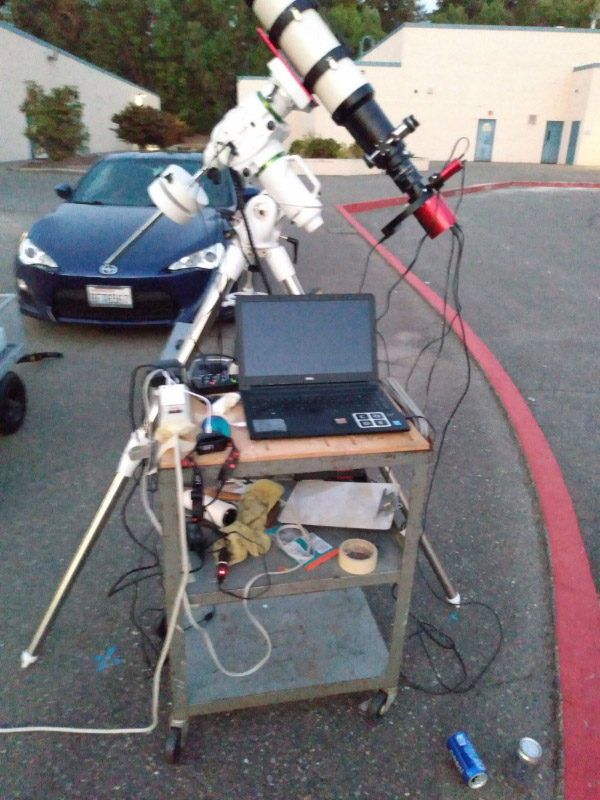
This telescope is designed primarily for viewing Deep Sky Objects (DSOs) such as galaxies and nebulae
This is the "main" telescope of my collection. When outfitted with all the gear shown here it is a remarkable instrument for astrophotography.
I *rarely* (if ever) use the eyepiece for this telescope. So far at least I have always used it only with our amazing ZWO astronomical CCD camera that you can see attached here-- it is that red cylinder hanging off the back of the telescope.
That CCD camera (Charged Couple Device) is the same type of camera found on our phones -- only more so. It has a resolution of 6248 x 4176 pixels (total 25mb).
I also set the temperature to -10 C so the electronics are kept very cold which makes for less electronic noise and therefore more detailed photographs.
Oddly enough I chose the more expensive B & W version of the camera. That version provides for a great deal more depth and detail of the resulting image.
Then, just like NASA with the various space telescopes we've all heard about, I take exposures using my RGB filters (See below) and then colorize the resulting combined image using Photoshop. The camera specs are HERE
The mount of the telescope is key: In addition to being very strong and stable, it also precisely tracks with the motion of the Earth. That mount also interfaces with my computer to allow for very precise aiming at DSOs. The specs for that mount are HERE
There is an electronic Filter Wheel (EFW) that allows me to switch between Red, Green, Blue, full spectrum light.
I recently bought and installed narrow band filters (H-Alpha, O-III and S-II if you are interested in the particulars) that provide even more detail when photographing DSO's. The specs for the narrow band filters are HERE
I use SmartCap Software to control virtually all operations of the telescope from tracking to selecting filters, managing the temperature of the camera and of course to set exposures when imaging with the camera. One particularly amazing feature allows me to "Live Stack" images of an object: I can take a 10 minute exposure, have the system verify that image falls within certain parameters and if it does, the program takes the data from that image and places it right on top of the previous image(s). That means I can get 60 minutes of data from 6 exposures. But WAIT, there's more. Each time the software 'stacks' an image it works to precisely align starts from the two image so the stacking image fits precisely over the existing stack. WHOA!
There is also a smaller HD camera that allows for minute 'tracking' of the telescope by locking onto individual stars. It works in conjunction with something called an "Off-Axis Guider (OAG)." When properly setup with the amazing mount it keeps the telescope 'drift' to only a few pixels out of the 6400 x 4800 pixel display. Truly astounding. The specs for the OAG are HERE. The specs for the smaller HD camera are HERE.
There is a heater/straps that wrap around the barrel of the telescope to keep it warm and to prevent the lens from fogging up when it gets cold/humid.
A customer of the store in Seattle that I buy/consult with was so impressed that my student Alex M. was able to get exo-planet data using our Celestron (below) that he donated the Tele Vue to me.
8" Celestron NextStar 8SE
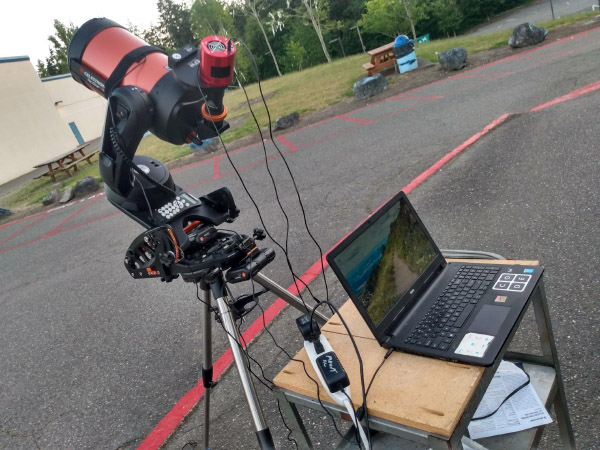
This telescope is designed primarily for viewing Solar System objects such as planets, the moon and the sun (with a filter of course!)
I bought this telescope to allow a student (Alex M.) to do exo-planet research in 2022.
A customer of the store in Seattle that I buy/consult with was so impressed that Alex was able to get data that he donated the Tele Vue to me.
Although this is a very capable telescope, it lacks many of the features for doing Deep Sky Object (DSO) imaging with my camera.
The Celestron works very nicely for viewing with the eyepiece. We'll bring it out to view planets and the moon.
I recently bought a solar filter. Once we get some nice afternoon weather I'll be taking that out for a spin. The specs for the solar filter are HERE. I've never done solar observing before and I'm *very* curious to see what we can see!
Celestron 4"
This beginner telescope is used by students interested learning telescope basics
It was donated to the school about 10 years ago by a community member who bought it to view Comet Halley when it last came by in 1986.
My student Alex M. used it to learn telescope basics before embarking on his ExoPlanet research project
National Geographic Solar Telescope
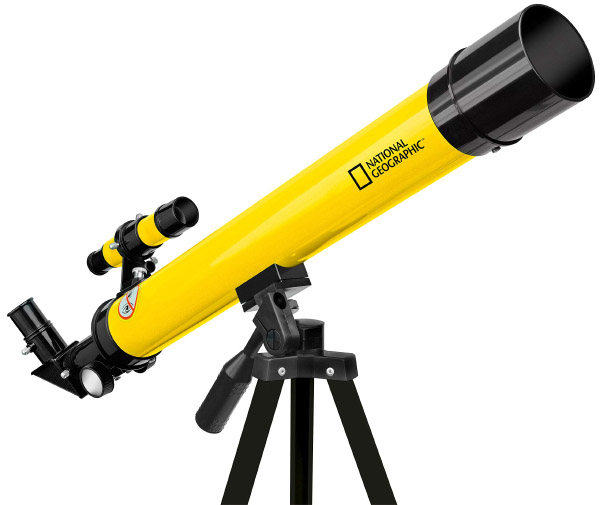
This small telescope is designed ONLY for looking at the sun.
I bought in preparation for viewing the Solar Eclipse down in Oregon in the summer of 2017. It was *amazing*
═══════════════════════════
Collection Notes:
All of these telescope with the exception of the 4" Celestron are mine. That is to say I bought them or in the case of the Tele Vue it was donated specifically to me (The donor was afraid if it went to the school it would end up in a closet collecting dust somewhere)
I am approaching the end of my teaching career. I'm not sure just when that will arrive, more than 1 year from now but most likely less than 5 years from now.
I'm hoping to implement a "viewing" program in the district to allow all the schools in PSD to benefit from this very cool equipment. If that effort is successful, I will donate ALL of this equipment to PSD.